

Camp Shinning FAQ
Yes, we are a professional organophilic clay supplier in China. Chinese Modifier Rheology Manufacturer.
Our annual capacity of organo bentonite is 20000MT. The bentonite powder is 15000MT.
Yes, Camp Shinning organoclay has own bentonite clay powder mine in the North of China. It can better ensure the quality of our organic bentonite clay raw materials.
Yes, Zhejiang Camp Shinning New Material Co.Ltd have Certificate of ISO9001:2015 and Certification for safe transport of Chemical Goods.
Camp Shinning organoclay is authorized as a certified supplier by the website of Made in China.
Camp Shinning organophilic bentonite have 20 years experience in the field of rheology modifier.
Camp Shinning organoclay mainly export to Russia, Brazil, Canada, Mexico, UAE,Saudi Arabia and Kuwait etc.
Because our organoclay applications are mainly used in oil fields, there are successful cases of our organic clay bentonite powder in those markets where is a large demand for drilling fluid chemicals.
Camp Shinning companies includes
Zhejiang Camp-Shinning New Material Co.Ltd (specialized in exporting rheology modifiers),
Chaoyang AutoFuLL Bentonite Co.Ltd (professional organoclay manufacturers in China) ,
Hangzhou Camp-Shinning Co.Ltd (Focus on domestic sales of rheology additive)
Zhejiang Camp-Shinning Electronic Co.Ltd. (An independent electronics company)
Yes,we welcome you to join our bentonite organoclay sales
Yes,our technical department and after-sales service department will provide you with professional training and services for organoclay rheological additive.
Our oilfield chemicals include organophilic clay ,organophilic lignite , emusifier ( primary and secondary emulsifiers)
We mainly participate China Coating Show. OTC USA,
Yes,we can supply free organoclay samples. The freight should from yourside.So we need you supply us your DHL account or fedex account.
Our min order is 1MT.
The delivery time about 7 to 10 working days after we receive your deposit.
Our payment terms are LC at sight or 30% TT in advance and 70% against copy BL.
The package: Kraft bag or kraft complex interior with PE or customized
Packing size: 25kg/bag or 500kg/bag or customize
16MT/20FCL with pallet, 18MT/20FCL without pallet, 25MT/40FCL with pallet.
Products should be stored in ventilated cool and dry place
Organoclay also named organophilic clay,rheology modifier ,rheological additive , Organic bentonite clay and organo bentonite etc.
Organoclay CAS is 68953 – 58 -2,composition of organoclay is Organic derivative of hectorite clay.
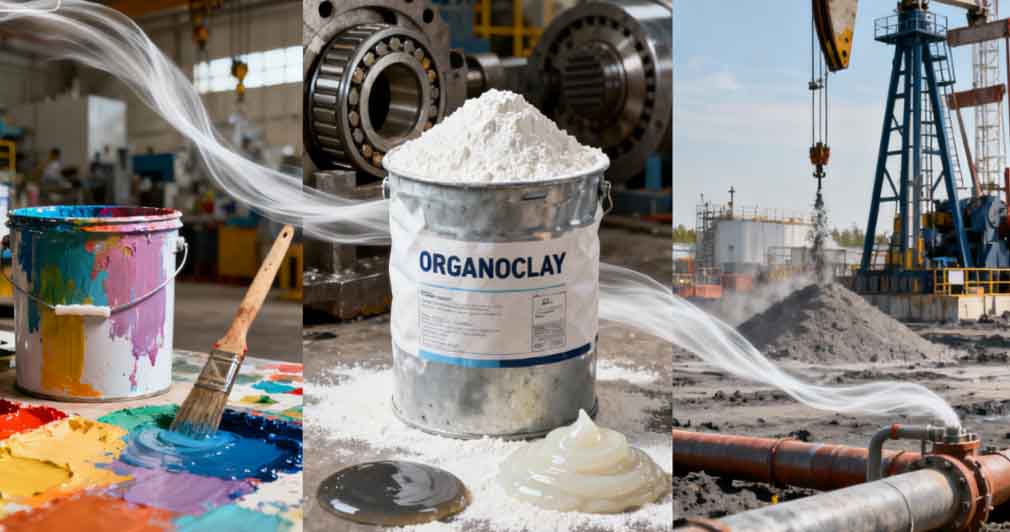
Organoclay is a bentonite montmorillonite clay,it is good gelling agent and thixotropic agent when as paint thickener and grease thickener.When as oilfield chemicals,
organophilic clay thickener powder is an important suspending agent and thickening agent . The rheological properties is very stable in oil drilling mud.
In terms of efficacy, organoclay can be called paint thickener, grease additive, ink additive and drilling additives and suspension agent etc.
organoclay where to buy? Contact us is your best choice,Zhejiang Camp-Shinning New Material Co.Ltd is located in Zhejiang China.Our sales Dept:
Mob(Whatsapp) : 0086-19817158171
Our sales representatives will reply you in 24 hours about your requirements.
Our organoclay applications includes organoclay for coatings,paints,organoclay grease, organoclay for oil drilling mud etc.
Organoclay CAS 68953 – 58 -2
organoclay hs code 2508.0000
Types of organoclay include water based organoclay (Water borne organoclay or inorganic clay ) and solvent based organoclay.
From an application perspective,it includes organic bentonite grease, rheological additives in cosmetics,rheology modifiers for waterborne paints, bentonite slurry,ink thickener (uv ink additives / printing ink additives / screen printing ink additives ) etc.
Composition of organoclay is montmorillonite clay quaternary ammonium salt.
We have many grades of rheology modifiers, the range of organoclay price is USD1500/MT to USD2500/MT. Different application need use different organic bentonite clay.
The organoclay manufacturing process and quality control process of organic clay is in the table as follows:
Crude bentonite ore from our mine (Pumping with water)→Bentonite slurry(purifying) → Purified bentonite slurry(Adding ammonium &other additive) → Modified bentonite slurry(filter press)→ Organoclay filter cake (drying)→ Organoclay powder (grinding)→ Organoclay powder→ Organoclay powder( packing)→ Final products organic bentonite clay
Organoclay activator, we recommend you: Methanol, ethanol, propylene carbonate, water etc.
In order to make good gelling agent and thixotropic agent,when use rheological additive,we suggest you make a pre gel firstly. It could keep the stable rheological properties in paint industry or grease industry or ink industry.
The steps are as follows:
- Make a pre gel
A ,Add 85-87% sovents or mixed solvents(mix)
B,Add 5-10% Camp Shinning organoclay (Dispersing at high speed(2500rpm) for 5-10 minutes)
C, Add polar actvartor, 3-5%(Dspersing at high speed(2500rpm) for 15-20 minutes
2 Addition method of pre- gel
A, For poor-wetting capacity resin systems(epoxy, polyester, short-oil alkyd,acrylic resin atc)
in combination with surfactant. if it can develop thixotropy structure under shear, additon process is as follows:
- Charge resin and solents(mix)
2 Camp Shinning organoclay pre gel (mix)
3 Surfactant
- Pigment (disperse)
- Dilute to desired viscosity
- For poor wetting capacity resin, non-thixotropic grind materials. if using surfactant, addition process is as follows:
1,Charge resin and solvents (mix)
- Surfactant (if required)
3 Pigment
- Disperse to desired fineness with grinding
- Camp Shinning organoclay pre-gel
6 Disperse completely to desired fineness
7 Dilute to desired viscosity
Yes,we can.Pls tell us your test method and your organoclay applications,our technical team will make an adjustment at our laboratories. Then we will supply you a full recommendation.
Pls mail to Camp Shinning organoclay sellers : [email protected]
Mob ( Whatsapp): 0086-19817158171
Our sales representatives will reply you in 24 hours about your requirements.
Pls mail to Camp Shinning organoclay sellers : [email protected]
Mob ( Whatsapp): 0086-19817158171
Our sales representatives will reply you in 24 hours about your requirements.
**Answer:** Organoclay is an organically modified bentonite rheology modifier that forms a reversible three-dimensional network in a compatible liquid system. At rest, that network builds low-shear viscosity and yield value, helping suspend pigments, fillers, barite, or other solids and reducing hard settling and sag. Under mixing, pumping, spraying, brushing, or printing shear, the structure partially breaks down so the formulation can flow; after shear stops, it rebuilds. This thixotropic behavior is why organoclay is used in solvent-based coatings, inks, adhesives, sealants, lubricating greases, and oil-based drilling fluids. Performance depends on solvent polarity, resin chemistry, temperature, shear input, addition order, and activation method. Select the Camp-Shinning grade by the complete formulation rather than by viscosity target alone, then confirm dosage and process in a laboratory drawdown, storage, or rheology test.
**Answer:** Sodium bentonite generally hydrates and swells more strongly in water, while calcium bentonite typically shows lower swelling and different ion-exchange behavior. These differences come from the dominant exchangeable cations between the smectite layers. For organoclay production, however, the label “sodium” or “calcium” does not by itself predict finished performance. Montmorillonite content, cation-exchange capacity, purification, particle-size control, organic treatment, and process consistency all influence the final rheology modifier. Buyers should therefore compare the finished Camp-Shinning grade in their actual resin, solvent, base oil, or drilling-fluid system. Use measurable targets—such as viscosity profile, gel strength, anti-sag, suspension, fineness, clarity, storage stability, or high-temperature behavior—instead of selecting only by the geological classification of the raw bentonite.
**Answer:** Bentonite is a clay-rich material composed mainly of smectite minerals, most commonly montmorillonite. Montmorillonite consists of extremely thin layered platelets with exchangeable ions and a high active surface area. Water or other compatible molecules can interact with the platelet surfaces and interlayer regions, producing swelling, adsorption, binding, and rheological effects. Untreated bentonite is naturally hydrophilic, so it is not automatically efficient in every organic liquid. Camp-Shinning organoclay grades are made by purifying and modifying suitable bentonite so the clay surface can interact more effectively with selected organic systems. The practical distinction is important: bentonite describes the mineral-based raw material, while organoclay or organophilic clay describes a modified rheology additive engineered for compatibility and performance in a defined formulation environment.
**Answer:** Camp-Shinning controls organoclay consistency through raw-material qualification, defined production checks, finished-batch testing, and batch traceability. The process starts with selected bentonite, followed by purification and controlled modification, filtration, drying, milling or particle-size control, packaging, and final inspection. Customer evaluation samples can be drawn from production material so the approved result is relevant to commercial supply. Before shipment, the applicable batch is checked against its specification; a labeled retention sample is kept to support later investigation. For purchasing approval, buyers should align the product specification with application tests such as gel efficiency, viscosity, fineness, moisture, dispersion, anti-settling, anti-sag, storage stability, or drilling-fluid rheology. A certificate of analysis should be reviewed against the agreed specification, while formulation performance should be confirmed with a representative production trial.
**Answer:** The correct activation route depends on the Camp-Shinning grade and the polarity and wetting characteristics of the formulation. CP-RL is designed for direct powder addition and can be introduced before grinding; a pre-gel is normally unnecessary. CP-180 is intended for low- to medium-polarity organic systems and develops best efficiency under high shear with a suitable polar activator; Camp-Shinning’s published starting range is typically 0.2%–2.0% CP-180 on total formulation weight, with activator at about 30%–40% of the organoclay weight. CP-APA is intended for polar to medium-polarity systems, but its addition route should follow the current grade TDS and a formulation trial.
**Answer:** An accurate organoclay quotation requires the grade or application, required quantity, packaging preference, destination, delivery term, and purchasing schedule. If the grade has not been selected, provide the resin or base-fluid type, solvent polarity, end use, target performance, current additive and dosage if available, and any temperature, color, clarity, regulatory, or processing constraints. For logistics, state the destination city or port and the preferred Incoterm, such as EXW, FOB, CFR, or CIF. Camp-Shinning can then separate product price from packaging, palletization, freight, documentation, and other route-dependent costs. Quotes should also identify their currency, validity period, estimated availability, payment terms, and specification basis so buyers can compare the total landed requirement rather than only a price per kilogram.
**Answer:** A sample or pilot evaluation is the preferred way to qualify a Camp-Shinning organoclay grade before scale-up. Start with enough material to run a control and several dosage or process variants in the actual formulation. Record raw-material lots, mixing speed, tip speed where available, temperature, addition order, activation time, and test age so the result can be reproduced. After laboratory screening, confirm the selected condition in a pilot or production-size batch because scale changes shear history, heat transfer, and wetting. Commercial minimum order quantity is not universal: it depends on grade, standard bag size, stock status, packaging, destination, and shipping method. Ask Camp-Shinning to quote the smallest practical trial shipment and the standard pallet or container option together, including freight and import-document implications.
**Answer:** Total delivery time is the sum of order confirmation, production or stock allocation, quality release, export preparation, carrier booking, international transit, customs clearance, and final delivery. These stages should be quoted separately because “ready to ship” is not the same as “delivered to site.” Timing varies with the Camp-Shinning grade and quantity, packaging or pallet requirements, sample approval, destination, Incoterm, vessel or flight schedule, port congestion, customs documentation, and seasonal capacity. For a dependable plan, request an estimated ex-works or cargo-ready date, the booking cut-off, estimated departure and arrival dates, document list, and a contingency window. Confirm the schedule again before placing a time-critical order, and keep safety stock when the additive is essential to continuous production.
**Answer:** Camp-Shinning can evaluate grade matching or product modification when a standard grade does not meet the required compatibility, rheology, appearance, temperature, or processing window. A useful technical brief should include the application, complete liquid phase, resin or base oil, solvent polarity, pigment or solids loading, manufacturing sequence, available shear equipment, service temperature, and measurable acceptance criteria. Examples include low-shear viscosity, yield point, gel strength, anti-sag, settling after aging, clarity, color, fineness, gloss, sprayability, pumpability, or barite suspension. The development path should begin with a confidentiality arrangement if needed, followed by a benchmark sample, laboratory screening, an agreed test method, and pilot validation. Custom development is a technical project, not an automatic performance guarantee; final suitability must be confirmed in the buyer’s complete formulation and production process.
**Answer:** Effective troubleshooting requires both batch identity and formulation-process evidence. Provide the Camp-Shinning product grade, batch or lot number, purchase and delivery references, package condition, storage history, photos of the label and material, and the relevant COA. Also send the full formulation or a technically useful non-confidential version, supplier and lot changes for key raw materials, organoclay dosage, addition order, activator type and level, mixer geometry, speed, mixing time, temperature, grind stage, dilution sequence, and test method. Describe the failure with data—for example viscosity drift, hard settling, poor sag resistance, seeds, low gel strength, loss of clarity, or inconsistent dispersion—and include a retained sample if requested. Keep the affected material segregated and do not discard packaging or records until the investigation is complete. Comparing the complaint batch with a retained control under the same method is usually the fastest route to separating material, storage, and process causes.
*Answer:** Camp-Shinning organoclay is supplied in moisture-protective export packaging, with published options for CP-180 including 25 kg or 22.68 kg kraft paper bags with a PE inner liner and customized packing on request. Published pallet configurations include approximately 800 kg or 1 metric ton, subject to the selected grade and shipping plan. Confirm the exact bag, pallet, and container configuration on the quotation because payload limits and route requirements vary. Store unopened bags in a cool, dry, ventilated indoor area, protected from rain, condensation, direct sunlight, and damaged pallets. Keep bags sealed until use, apply first-in-first-out stock rotation, and reseal partial bags promptly to limit moisture pickup and contamination. CP-180 has a published shelf life of two years under proper storage; use the TDS, label, or sales confirmation for the shelf life of other grades.
**Answer:** Before approval, request the current technical data sheet, safety data sheet, representative or lot-specific certificate of analysis, packaging details, shelf-life and storage guidance, and a sample for formulation testing. Depending on the market and application, also identify any customs, transport, composition, regulatory, or compliance documents needed before ordering. A TDS defines typical properties and use guidance; a COA reports results for a particular batch; an SDS covers hazards, handling, first aid, and disposal. None of these replaces an application trial. Build a qualification protocol around the real failure modes of the finished product, such as dispersion fineness, viscosity at relevant shear rates, thixotropic recovery, sag, settling, storage aging, freeze-thaw or heat exposure where relevant, clarity, gloss, grease consistency, or drilling-fluid rheology. Approve the grade, dosage, process, and acceptance limits together.
**Answer:** The best shipping method depends on quantity, urgency, destination, cost, route reliability, and the transport classification shown in the current SDS. Courier or air freight is usually considered for small, time-sensitive samples or qualification quantities; sea freight is generally more economical for palletized or container-scale orders. Road or rail can be practical where cross-border routes and local infrastructure support them, and multimodal transport may combine several methods. Before booking, confirm the Incoterm, chargeable weight or volume, pallet dimensions, moisture protection, labeling, document set, customs requirements, cargo insurance responsibility, and final-mile delivery. Ask Camp-Shinning for at least one cost-focused and one time-focused option when the production schedule is sensitive. The carrier and route must be selected from the actual shipment details, not from a generic statement that every mode is available to every destination.
Order Online
Please send your message to us
*We will reply your inquiry to this Email as soon as we see it