

Organoclay Bentonite for Grease Manufacturing Using Recycled Waste Oil & Used Mobil Oil
Organoclay bentonite for grease manufacturing: High-performance organoclay bentonite thickener for grease production. Suitable for formulation with recycled waste oil and used Mobil oil. Stable thickening effect for all waste oil lubricant lab testing. Contact us for samples.
Our grease-grade organoclay bentonite serves as an efficient non-soap thickener ideal for grease formulation.
It works excellently for customers developing grease based on recycled waste oil and used Mobil engine oil. Many formulators carry out multiple lab trials on different waste oil feedstocks, and our organoclay delivers stable thickening performance for various recycled base oils.
Organoclay bentonite for grease manufacturing
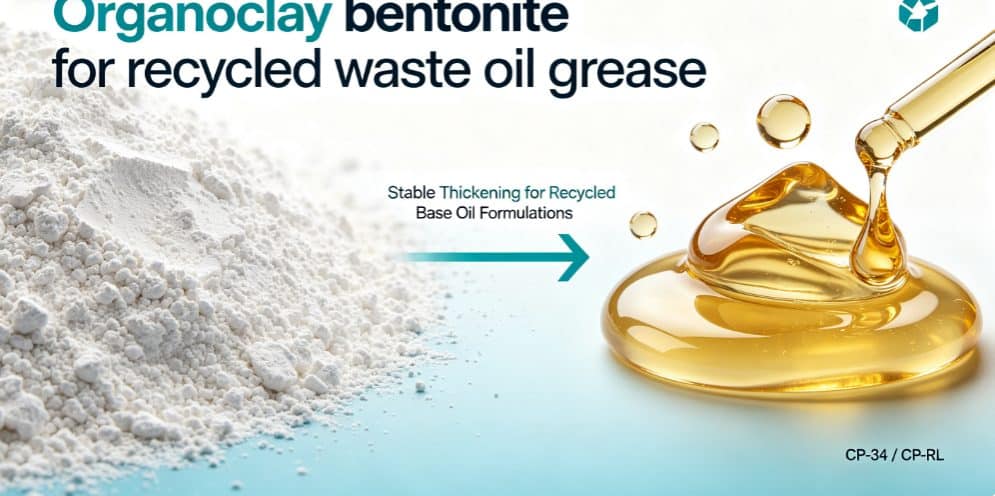
Advantages of Our Organoclay Bentonite for Waste Oil Grease | Organoclay bentonite for grease manufacturing
Q:Can your organoclay bentonite be used to produce grease with recycled waste oil /used Mobil oil?
A:Yes, our grease-grade organophilic clay is compatible with various recycled waste engine oils. It can be adopted for your formulation tests with different waste oil varieties.
Q1: Can CP-RL and CP-34 organoclay bentonite be used to produce grease with recycled waste oil & used Mobil engine oil? Organoclay bentonite for grease manufacturing
A: Yes, both CP-RL and CP-34 are applicable thickeners for grease manufacturing with recycled waste oil, re-refined waste motor oil and used Mobil oil.
CP-RL is solvent-based organoclay compatible with low/medium/mid-high polarity recycled base oil systems, featuring easy direct powder addition and stable rheology performance.
Organoclay bentonite for grease manufacturing CP-34 delivers excellent gelling efficiency for various mineral waste oils, showing consistent thickening effect when you test multiple types of waste oil feedstock as you mentioned. Both grades can build stable bentonite grease structure without severe stratification or oil bleeding even with impure recycled waste oil.
Q2: What are the key advantages of CP-RL & CP-34 for waste oil grease formulation?
A:
Easy dispersion: Fine particle size (CP-RL fineness ≥98% below 74μm, dispersion fineness ≤20μm), can be added directly as powder before grinding;
Post-adjustment function: If finished grease penetration or consistency fails testing, extra small amount of CP-RL/CP-34 can be supplemented to adjust rheology without reworking the whole batch;
Stable thickening in mixed waste oil: Tolerant to unstable components in recycled Mobil/waste oil, uniform thixotropy and long-term anti-settling;
Low moisture ≤3.5% and controlled ignition loss, avoiding foam and abnormal viscosity in waste oil grease production.
Organoclay bentonite for grease manufacturing
Q3: What is the recommended dosage of CP-RL / CP-34 for waste oil grease?
A: General addition level ranges from 0.2%–2.0% based on total formulation weight.
If your recycled waste oil has high impurity content or light viscosity base oil, you can increase dosage to 1.0%–2.0% for sufficient gel strength. For clean re-refined Mobil waste oil, 0.3%–1.0% normally meets standard grease consistency. Adding before grinding procedure maximizes thickening efficiency.
Q4: Do I need polar activator and pre-gel process when using CP-RL/CP-34 in waste oil grease?
A: CP-RL supports direct powder feeding without mandatory pre-gel or polar activator, which simplifies your lab test workflow for different waste oil samples.
If you pursue higher gel strength and better high-temperature resistance for finished grease, adding polar activator and conducting pre-gel treatment will deliver upgraded performance. CP-34 works better with polar activator (95% ethanol/methanol water mixture) during high-shear dispersion for recycled oil systems.
Q5: What’s the difference between CP-RL and CP-34 for waste oil grease testing? Which one should I choose?
A:
CP-RL (solvent-based organoclay): Light yellow fine powder, wider polarity compatibility, simpler operation (no must-have activator), ideal for quick lab screening of various waste/Mobil oil types; perfect if you want flexible post-adjustment for trial batches.
CP-34: White powder, higher gelling efficiency, lighter grease color, more stable for long-term storage of finished waste oil grease. Suitable for mass production of standard recycled oil bentonite grease after you finish lab screening.
We suggest you test both grades side by side with your different waste oil samples to compare penetration, dropping point and oil separation performance.
Organoclay bentonite for grease manufacturing
Q6: Will CP-RL / CP-34 cause oil bleeding when using low-quality recycled waste oil?
A: Hardly any bleeding under proper high-shear dispersion. Our organoclay has consistent rheology development capacity to lock waste oil molecules. For heavily contaminated waste Mobil oil, slightly raise organoclay dosage and extend grinding time to eliminate oil separation issues.
Q7: Can you provide free samples of CP-RL and CP-34 for our waste oil grease lab testing?
A: Yes, we supply trial samples of CP-RL and CP-34 for your formulation tests with different recycled waste oil & used Mobil oil. We can also offer technical guidance on dispersion process, activator selection and dosage adjustment according to your waste oil raw material index. Just send us your test requirements and sample quantity demand.
Q8: What other applications do CP-RL and CP-34 cover besides waste oil grease?
A: As listed in CP-RL technical data sheet, both grades are multi-purpose rheological additives, also widely used in industrial paints, sealants, adhesives, printing inks, cosmetics and nano-composite materials besides grease production.
Q9: What are the typical physical specs of CP-RL organoclay for grease reference?
A:
Composition: Organic modified montmorillonite clay
Appearance: Light yellow fine powder
Moisture (105℃,2h): ≤3.5%
Loss on ignition (1000℃): ≤33%
Bulk density: 0.35~0.45g/cm³
Fineness (<74μm): ≥98%
Dispersion fineness: ≤20μm
Organoclay bentonite for grease manufacturing
Order Online
Please send your message to us
*We will reply your inquiry to this Email as soon as we see it