

Organoclay for Plastics and Polymer Nanocomposites
CP-180 Organoclay for Plastics and Flame-Retardant Nylon 6
Reduce Flame-Retardant Loading and Lower Plastic Compound Costs
Organoclay for Plastics CP-180 is an organoclay designed for use in plastics, polymer composites and flame-retardant engineering plastics.
In our internal flame-retardant Nylon 6 trial, CP-180 helped reduce the required flame-retardant loading by more than 50%. At the same time, the finished compound cost was reduced by approximately USD 2 per kilogram.
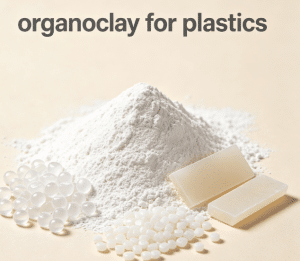
This provides plastic compounders with a practical way to reduce formulation cost while maintaining the performance requirements of flame-retardant nylon systems.
Organoclay for Plastics CP-180 can help plastic manufacturers:
- Reduce the amount of expensive flame retardant required
- Lower the total cost per kilogram of the finished compound
- Reduce the potential corrosive effect of high flame-retardant loading on molds
- Reduce odor associated with excessive flame-retardant content
- Help reduce the potential emission burden from high additive loading
- Improve reinforcement and dimensional stability
- Develop more cost-efficient engineering plastic formulations
[Request CP-180 Sample]
[Talk to a Technical Specialist]
Organoclay for Plastics CP-180 for Plastics: A More Cost-Efficient Functional Additive
Many flame-retardant plastic formulations rely on relatively high levels of flame-retardant additives. However, flame retardants are often more expensive than the base resin and may create additional processing challenges.
Excessive flame-retardant loading may also contribute to:
- Higher compound cost
- Increased odor during processing
- More difficult processing
- Potential mold corrosion
- Reduced mechanical performance
- Higher additive-related emissions
Organoclay for Plastics CP-180 provides a modified clay structure that can work as a reinforcing and flame-retardant synergistic additive in selected polymer systems. By improving the efficiency of the formulation, CP-180 may allow manufacturers to achieve the required performance with a lower amount of conventional flame retardant.
The actual reduction will depend on the polymer type, flame-retardant chemistry, compatibilizer, processing conditions and target performance requirements. Laboratory testing is recommended before commercial production.
Internal PA6 Flame-Retardant Trial
Our Organoclay for Plastics CP-180 trial in flame-retardant Nylon 6 produced a clear formulation advantage.
Trial result
- Polymer system: Flame-retardant Nylon 6
- Additive evaluated: CP-180 organoclay
- Flame-retardant loading: Reduced by more than 50% in the internal formulation trial
- Finished compound cost: Reduced by approximately USD 2/kg
- Additional potential benefits: Lower additive cost, lower odor and reduced potential mold-corrosion concerns
This result demonstrates the potential of CP-180 as a cost-reduction additive for flame-retardant nylon compounds.
The result should be considered a formulation reference rather than a universal guarantee. Each customer should conduct its own testing based on resin grade, flame-retardant package, screw configuration, processing temperature and required flame-retardant rating.
What Are Organoclay, Organophilic Clay, Organomodified Clay and Organobentonite?
These terms are closely related but emphasize different characteristics.
Organoclay for Plastics is the general term for clay that has been organically modified to improve its compatibility with organic polymers, resins or non-aqueous systems.
Organophilic clay emphasizes the clay’s improved affinity for organic materials. It is more compatible with polymer matrices than untreated hydrophilic clay.
Organomodified clay describes clay that has been chemically modified with organic components to change its surface properties and improve dispersion in selected polymer systems.
Organobentonite generally refers to bentonite or montmorillonite clay that has been organically modified. It is one type of organoclay.
CP-180 is based on an organic derivative of montmorillonite clay. In suitable plastic formulations, it can be used as a functional additive for reinforcement, flame-retardant synergy and performance improvement.
How Does CP-180 Work in Plastic Formulations?
When properly selected and dispersed, CP-180 can interact with the polymer matrix and other additives.
Its layered clay structure may help to:
- Improve reinforcement of the polymer matrix
- Increase stiffness and modulus
- Improve dimensional stability
- Support thermal performance
- Improve the efficiency of flame-retardant systems
- Reduce the amount of conventional additive required
- Improve the performance-to-cost ratio of the final compound
The final result depends strongly on compatibility and dispersion. The same organoclay grade may perform differently in different polymers, so grade selection and formulation testing are important.
Organoclay for Nylon and Flame-Retardant PA6
CP-180 is particularly suitable for evaluation in flame-retardant nylon systems, including Nylon 6 and Nylon 66.
Potential benefits include:
- Reduced flame-retardant loading
- Lower formulation cost
- Improved stiffness
- Improved dimensional stability
- Better reinforcement of the nylon matrix
- Lower potential odor from excessive additive loading
- Reduced potential mold-corrosion concerns caused by high additive levels
For Nylon 6, the compatibility between the organoclay, polymer matrix and flame-retardant package should be carefully evaluated. The final formulation should be tested for flame-retardant rating, tensile strength, impact strength, thermal stability and processing behavior.
Organoclay for Polypropylene
Organoclay for polypropylene is commonly evaluated in PP compounds that require improved stiffness, reinforcement, dimensional stability or barrier performance.
CP-180 may be considered for:
- Flame-retardant polypropylene
- Automotive PP compounds
- Appliance housings
- Industrial molded parts
- Reinforced polypropylene
- PP nanocomposite formulations
For polypropylene systems, the use of a suitable compatibilizer may improve the interaction between the organoclay and the non-polar polymer matrix.
Organoclay for HDPE and Polyethylene
Organoclay for HDPE can be evaluated in polyethylene compounds that require improved stiffness, thermal performance, dimensional control or barrier properties.
Potential applications include:
- HDPE containers
- Plastic packaging
- Industrial plastic parts
- Pipes and fittings
- Polyethylene films
- Recycled polyethylene compounds
Because HDPE and polyethylene are relatively non-polar polymers, dispersion and compatibility are important factors. The use of a suitable coupling or compatibilizing system may be required depending on the formulation.
Organoclay for Engineering Plastics
Organoclay for engineering plastics can be used in selected high-performance polymer systems where reinforcement, thermal stability and flame-retardant efficiency are important.
Potential engineering plastic applications include:
- Nylon 6 and Nylon 66
- Polypropylene engineering compounds
- PBT compounds
- ABS compounds
- Polymer blends
- Flame-retardant molded components
- Electrical and electronic plastic parts
- Automotive plastic components
The appropriate grade should be selected according to polymer polarity, processing temperature, flame-retardant chemistry and required mechanical properties.
CP-180 Product Advantages
CP-180 is designed to provide functional performance in selected polymer and organic systems.
Key advantages include:
- Organic-modified montmorillonite structure
- Good reinforcing potential
- Support for flame-retardant formulations
- Potential reduction in conventional flame-retardant loading
- Improved cost efficiency
- Fine powder form
- Compatibility with selected polymer composite systems
- Suitable for technical evaluation in Nylon 6, PP, HDPE and engineering plastics
CP-180B: Improved Fine-Dispersion Grade
CP-180B is an improved grade of CP-180. It is finer and easier to disperse compared with the standard CP-180 grade.
CP-180B is an organoclay based on an organic derivative of montmorillonite and is designed for selected intermediate- and low-polarity organic systems, nanocomposites and other applications requiring improved dispersion.
CP-180B Typical Properties
| Property | Typical Value |
|---|---|
| Composition | Organic derivative of montmorillonite clay |
| Appearance | Fine powder, light yellow |
| Moisture content, 105°C for 2 hours | ≤3.5% |
| Loss on ignition, 1000°C | 29–32% |
| Bulk density | 0.53 g/cm³ |
| Fineness below 74 μm | ≥98% |
The above values apply to CP-180B and should not automatically be used as the specification for CP-180 unless confirmed by the technical department.
Processing and Dispersion
CP-180 should be evaluated through a controlled compounding process.
Important factors include:
- Polymer type and polarity
- Flame-retardant chemistry
- Compatibilizer selection
- Mixing sequence
- Screw configuration
- Shear level
- Processing temperature
- Moisture control
- Residence time
- Final dispersion quality
For CP-180B, the standard technical information indicates that high-shear dispersion is recommended. The exact addition level and processing conditions should be established through laboratory trials.
A typical evaluation may include:
- Dry the polymer and additives according to the resin supplier’s instructions.
- Premix CP-180 with the selected flame-retardant package and compatibilizer.
- Introduce the mixture through a suitable twin-screw extrusion process.
- Check dispersion, melt flow, mechanical properties and flame-retardant performance.
- Optimize the formulation according to the required end-use standard.
No single addition level is suitable for every plastic system. The final dosage should be determined by testing.
Why Choose Camp-Shinning CP-180?
Camp-Shinning provides organoclay and organophilic clay products for coatings, grease, sealants, nanocomposites and polymer applications.
With CP-180, plastic compound manufacturers can evaluate a practical additive solution for:
- Flame-retardant Nylon 6
- Nylon 66 compounds
- Polypropylene composites
- HDPE and polyethylene systems
- Engineering plastics
- Polymer nanocomposites
- Cost-reduction formulations
Our technical team can help customers evaluate CP-180 according to their resin type, flame-retardant package, processing method and target performance.
Frequently Asked Questions
Organoclay Additive for Plastics: Reinforcement and Flame-Retardant Performance
Can CP-180 be used in plastics?
Yes. CP-180 can be evaluated in selected plastic, polymer composite and engineering plastic formulations. It is especially suitable for testing in flame-retardant Nylon 6 and other polymer systems requiring reinforcement or flame-retardant synergy.
Organoclay for Polypropylene, Nylon, HDPE and Engineering Plastics
Can CP-180 reduce flame-retardant usage?
In our internal flame-retardant Nylon 6 trial, CP-180 helped reduce flame-retardant loading by more than 50%. The actual result depends on the complete formulation and must be confirmed through customer testing.
Can CP-180 be used for polypropylene?
Yes. CP-180 can be evaluated as an organoclay for polypropylene, particularly in reinforced PP, flame-retardant PP and polymer nanocomposite applications.
Organophilic Clay for Polymer Composites and Flame-Retardant Plastics
Can Organoclay for Plastics CP-180 be used for HDPE?
CP-180 can be evaluated in HDPE and polyethylene compounds. Compatibility, dispersion and the use of a suitable compatibilizer should be considered.
Is organobentonite the same as organoclay?
Organobentonite is generally a bentonite- or montmorillonite-based type of organoclay. Organoclay is the broader term, while organophilic clay emphasizes compatibility with organic materials.
How much Organoclay for Plastics CP-180 should be added?
The appropriate addition level depends on the resin, flame-retardant package, target rating and processing method. Laboratory testing is required to determine the optimum dosage.
Cost-Effective Organoclay for Plastics and Engineering Plastic Compounds
Can you provide samples and technical documents?
Yes. Camp-Shinning can provide samples, technical data and product documentation for customer evaluation.
Request a Organoclay for Plastics CP-180 Plastic Application Sample
Are you developing flame-retardant Nylon 6, polypropylene, HDPE or another engineering plastic compound?
Contact Camp-Shinning to discuss:
- Organoclay for Plastics CP-180 and CP-180B sample evaluation
- Flame-retardant loading reduction
- Polymer compatibility
- Dispersion recommendations
- Technical documentation
- Cost-reduction opportunities
Request a Organoclay for Plastics CP-180 sample and discuss your plastic formulation with our technical team.
Organophilic Clay for Plastics: Applications in Nylon, PP and HDPE