

Organoclay for asphalt coating | Anti-sag Anti-settling
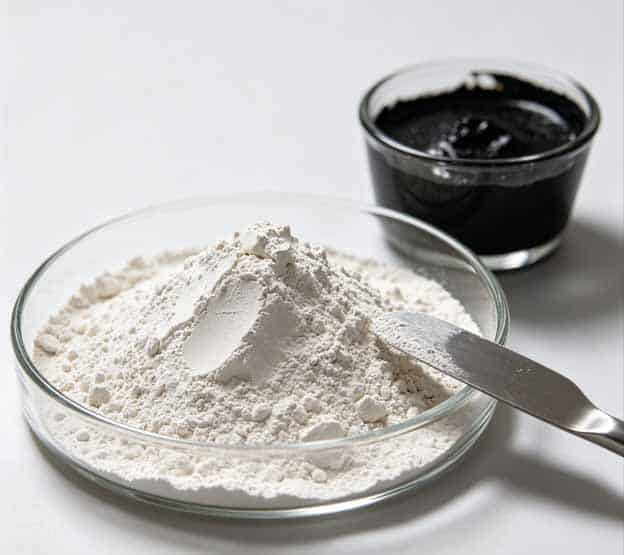
Organoclay for asphalt coating,Camp-Shinning organoclay (organobentonite) is a rheology additive for asphalt anticorrosive coating. Provides anti-sag & anti-settling performance for bitumen pipe coating.
Organoclay for asphalt coating | Rheology Additive for Bitumen Paint
Organoclay for asphalt coating: When Camp-Shinning’s organobentonite is used as a thixotropic agent in asphalt coatings, its dispersibility depends on whether high shear and polar activators are used, as these directly affect the dispersion performance of the asphalt coating.
It is also widely used in asphalt anti-corrosion coatings for steel pipes. This bentonite rheology modifier is used in solvent-based asphalt and asphalt anti-corrosion coatings. If you want to improve the viscosity and thixotropy of asphalt coatings, then using CP-RL is a proper specification choice because it can improve the coating’s flowability and suspension properties.
The biggest advantage of this organic bentonite used in asphalt coatings is its anti-settling properties, excellent thixotropic properties, controllable viscosity, good compatibility with other solvents, strong anti-sagging properties, and easy dispersion.
Organo clay also requires very low dosage, making it a very economical and efficient rheology modifier for asphalt coatings.
A: Organoclay is mainly added to solvent-based asphalt bitumen coatings for buried steel pipeline anticorrosion.
Typical end uses include:
– Buried oil, gas and water transmission pipeline asphalt anticorrosive coating
– Steel pipe exterior bitumen primer and topcoat
– Storage tank base bitumen anti-corrosion paint
– Steel structure bitumen protective coating for underground facilities
During coating manufacturing, organoclay is added in the grinding stage to form a stable thixotropic network.
Organoclay for asphalt coating
Rheology modifiers ensures uniform suspension of mineral fillers and enables thick film application without sagging on pipe surfaces.
If you want organobentonite to have good dispersibility and activation throughout the formulation in asphalt anticorrosive coatings, we recommend that you adopt and refer to the following suggestions:
1. Disperse the organobentonite under high-speed shear.
2. Add a polar activator, such as methanol or propylene carbonate, which can fully activate its rheological properties.
3. Continue grinding to the required fineness when adding pigments, fillers, and asphalt resin.
4,Our recommended usage range is generally 0.8% to 2.0% of the total coating weight, depending on your thixotropic requirements. We also recommend maintaining high-shear mixing for a sufficient time to form a uniform gel effect and strength.
Organoclay Rheology Modifier for Asphalt Bitumen Anticorrosive Coating
Organoclay for asphalt coating
Aluminum flake is heavy and flat. In solvent-based paint, it settles fast. Leave a drum in the warehouse for a couple of months, you get hard cake at the bottom that even a pneumatic mixer struggles to re-disperse. Then you spray it on a vertical panel—sagging streaks, poor flake orientation, patchy metallic finish. General-purpose thickeners either don’t hold the flakes at rest or don’t thin out enough under shear. You can’t spray what feels like peanut butter.
What you need is reversible thixotropy: thick when still, thin when moving. That’s exactly what organophilic clay does.
Organophilic solvent-compatible clay could solve all your problems.
Order Online
Please send your message to us
*We will reply your inquiry to this Email as soon as we see it