

Organoclay for Road Marking Paint: CP-34 for Solvent-Based Acrylic Traffic Paint
Looking for organoclay for road marking paint to control viscosity, prevent pigment settling, and improve application stability? CP-34 organic bentonite is a rheology additive for compatible solvent-based coating systems, including solvent-based acrylic road and pavement marking paints.
This guide explains how organoclay works in traffic marking formulations, its main benefits, recommended dosage, dispersion and activation methods, technical properties, and application limitations.
1. What Is Organoclay for Road Marking Paint?
Organoclay, also called organic bentonite or organophilic bentonite, is a rheology additive used in suitable solvent-based road marking paint formulations. It is produced by modifying montmorillonite clay with organic compounds to improve its compatibility with selected organic solvents and resin systems.
When properly dispersed and activated in a compatible formulation, organoclay forms a reversible three-dimensional network that provides thixotropic behavior. This network helps control viscosity, maintain pigment and filler suspension, and improve consistency during storage and application.
CP-34 is a modified bentonite grade designed for compatible solvent-based systems, ranging from low-polarity to medium-high-polarity solvent environments. As a rheology modifier for solvent road marking paint, it can be evaluated for viscosity control, anti-settling performance, and anti-sag properties.
Paint manufacturers searching for organoclay for traffic marking paint or organoclay for pavement marking paint can consider CP-34 for laboratory trials in their solvent-based acrylic formulations.
2. Key Benefits of Organoclay in Solvent Road Marking Paint
2.1 Anti-Settling Performance
Pigments and mineral fillers can gradually settle when road marking paint remains in storage. Excessive settling may cause hard sediment, uneven composition, and additional work during remixing.
Organoclay builds a thixotropic structure that helps suspend pigments such as titanium dioxide (TiO₂) and compatible fillers. Depending on the formulation and particle characteristics, it may also help maintain the distribution of reflective glass beads where these are incorporated into the same paint system.
As an anti-settling additive for road marking paint, CP-34 can help reduce settling and improve redispersibility. Actual results should be verified through storage stability and sedimentation tests.
2.2 Anti-Sag and Anti-Run Control
After spraying, brushing, or rolling, road marking paint needs to maintain the intended film profile instead of flowing excessively on asphalt or concrete.
Organoclay can help the coating recover viscosity after application shear, improving resistance to sagging and running. As an anti-sag agent for traffic paint, CP-34 can help maintain marking uniformity and edge definition when the dosage and formulation are properly optimized.
2.3 Shear-Thinning and Thixotropic Behavior
Organoclay acts as a thixotropic additive for acrylic solvent marking paint. Under sufficient shear during mixing, pumping, or spraying, the internal structure breaks down and apparent viscosity decreases. Once the shear force is removed, the structure gradually rebuilds.
This behavior can balance application flow with resistance to settling and sagging, helping paint manufacturers achieve the rheological profile required by their formulations.
2.4 Consistent Rheology and Light-Colored Gel
CP-34 is designed to develop rheology in compatible solvent systems. Its light-colored gel may be useful in formulations where additive color is an important consideration.
As organic bentonite for road marking coating, CP-34 can be evaluated for repeatable thixotropy, storage stability, and film properties. Final performance depends on the binder, solvent blend, pigment loading, processing conditions, and dosage.
3. Recommended Grade and Typical Dosage
CP-34 is a candidate grade for solvent-based acrylic road marking paint and other compatible solvent-borne coatings. The following starting parameters can be used to plan laboratory evaluation.
| Parameter | Recommendation |
|---|---|
| Recommended grade | CP-34 |
| Typical dosage | 0.5%–1.5% of total paint weight |
| Main function | Rheology adjustment, anti-settling, and anti-sag control |
| Target application | Compatible solvent-based acrylic road and pavement marking paint |
| Solvent compatibility | Low-polarity to medium-high-polarity systems, subject to formulation testing |
| Processing | Dispersion and activation according to the grade and formulation requirements |
The dosage of organoclay for road marking paint should be adjusted according to pigment and filler loading, solvent polarity, resin compatibility, application method, and required viscosity recovery.
A practical evaluation should compare different addition levels and measure viscosity, thixotropic recovery, sedimentation, redispersibility, and application performance. Confirm the optimum dosage before scaling up production.
4. Dispersion and Activation Guide
Proper dispersion and activation are important for conventional organoclay grades. Incomplete dispersion or insufficient activation can result in weak gel development and inadequate rheology control.
Step 1: Prepare the Solvent and Resin Premix
Prepare a compatible solvent/resin premix according to the coating formulation. Confirm that the solvent blend is suitable for the selected organoclay grade.
Step 2: Add Organoclay Under High Shear
Gradually add CP-34 to the premix while mixing. A starting mixer speed of approximately 1,500–3,000 rpm may be evaluated, but the actual dispersion conditions should be adjusted for the mixer type, impeller diameter, batch size, and required tip speed.
Step 3: Evaluate the Need for a Polar Activator
Depending on the grade and solvent system, a polar activator such as methanol, ethanol, or propylene carbonate may be considered. Select the activator and addition level according to the product's technical guidance, formulation compatibility, and applicable safety requirements.
Step 4: Continue Mixing and Check Gel Development
Continue high-shear mixing and evaluate the dispersion. A mixing period of approximately 15–30 minutes may serve as an initial trial range, but the required time depends on the equipment and formulation. Confirm that the desired rheology has developed rather than relying on mixing time alone.
Step 5: Add Pigments and Fillers
After establishing the required organoclay structure, proceed with the remaining formulation steps according to the paint manufacturing process. Add pigments, fillers, reflective glass beads where applicable, and other additives at suitable stages.
5. Suitable and Unsuitable Applications
5.1 Suitable Applications
CP-34 can be evaluated as organic bentonite for road marking coating in compatible solvent-based formulations, including:
- Solvent-based acrylic road marking paint
- Solvent-borne pavement marking paint
- Solvent-based highway and road line marking paint
- Parking lot marking paint
- Airport runway marking paint formulated with compatible solvent-borne binders
Other potential applications in compatible solvent-borne coatings include:
- Anti-corrosion coatings
- Epoxy coatings
- Alkyd coatings
- Nitrocellulose (NC) wood coatings
- Polyurethane (PU) wood coatings
Compatibility should be assessed separately for each resin and solvent combination.
5.2 Unsuitable or Formulation-Dependent Applications
Water-Based Road Marking Paint
Conventional solvent-grade CP-34 is not designed to swell and develop its normal rheological structure directly in water. Waterborne road marking systems generally require suitable water-based rheology additives, such as compatible inorganic bentonite or dedicated waterborne thickeners.
Thermoplastic Road Marking Paint
Thermoplastic road marking materials use a different formulation and application process from solvent-based acrylic paints. CP-34 is not recommended as a standard rheology additive for this system without specific compatibility and performance evidence.
100% UV-Curable Marking Coatings
Compatibility in 100% UV-curable systems depends on the polarity and composition of the formulation. Dedicated testing is necessary before selecting CP-34.
6. CP-34 Technical Properties
The following table summarizes the typical technical properties provided for CP-34 organic bentonite. These values should be checked against the current product technical data sheet and the applicable specification for the supplied grade.
| Property | Typical Specification |
|---|---|
| Composition | Organic derivative of montmorillonite clay |
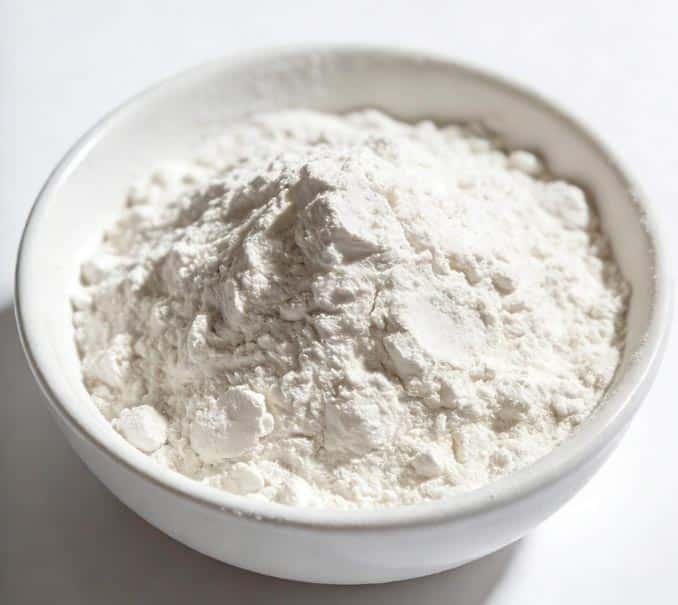
| Appearance | Fine powder, light yellow |
| Moisture content (105°C, 2 hours) | ≤ 3.5% |
| Loss on ignition (1,000°C) | 28%–30% |
| Bulk density | 0.53 g/cm³ |
| Fineness (<74 μm) | ≥ 98% |
Main Advantages at a Glance
- Efficient gel development in compatible solvent systems
- Light-colored gel
- Thixotropic rheology for viscosity recovery and sag control
- Helps maintain pigment and filler suspension during storage
- Can improve redispersibility and reduce hard settling when properly formulated
- Potential to support consistent coating application and film formation
7. Frequently Asked Questions
Q1. Can CP-34 organoclay be used in water-based road marking paint?
No. CP-34 is a conventional solvent-grade organoclay and is not designed to develop its normal structure directly in waterborne systems. Water-based road marking paint generally requires compatible inorganic bentonite or dedicated waterborne rheology additives.
Q2. Does organoclay help prevent glass beads from settling in traffic paint?
Organoclay can help suspend pigments and fillers by developing a thixotropic network. It may also help maintain glass bead distribution in compatible formulations, depending on bead size, density, loading, and the overall rheology. Performance should be confirmed through formulation and storage tests.
Q3. What is the recommended dosage of organoclay for road marking paint?
A typical starting range for CP-34 is 0.5%–1.5% based on total paint weight. The optimum dosage depends on the resin, solvent polarity, pigment and filler loading, and required rheological properties. Laboratory testing is necessary to establish the final addition level.
Q4. Which organoclay grade is suitable for low-polarity solvent road marking paint?
Organoclay for road marking paint CP-34 can be evaluated in compatible solvent systems ranging from low polarity to medium-high polarity. Its suitability for a particular low-polarity acrylic formulation should be verified through dispersion, activation, viscosity, and storage stability tests.
Q5. How does organoclay work as a thixotropic additive for acrylic solvent marking paint?
Organoclay develops a reversible network within a compatible solvent/resin blend. The structure helps suspend pigments and fillers during storage, breaks down under application shear, and rebuilds after shear is removed. This behavior can support viscosity recovery and resistance to sagging when the formulation is properly optimized.
Q6. What is the difference between organoclay and fumed silica in road marking paint?
Both organoclay and fumed silica can be used as rheology additives, but their thickening mechanisms, dispersion requirements, compatibility, and effects on the finished coating can differ. The appropriate choice depends on the resin/solvent system, application requirements, processing equipment, and target performance. Comparative laboratory testing is recommended.
Q7. Is CP-34 suitable for all solvent-based road marking paints?
No single organoclay grade is suitable for every formulation. Organoclay for road marking paint CP-34 is a candidate for compatible solvent-based systems, but resin chemistry, solvent polarity, activator requirements, pigment loading, and manufacturing conditions can affect performance. Confirm compatibility before commercial production.
8. Contact Camp-Shinning for CP-34 Organoclay
If you are sourcing organoclay for road marking paint, organoclay for traffic marking paint, or organoclay for pavement marking paint, CP-34 is a candidate grade to evaluate in compatible solvent-based acrylic formulations.
Camp-Shinning supplies organoclay and organic bentonite for industrial rheology applications. To help assess grade suitability, please share your resin type, solvent blend, pigment and filler loading, current thickener, and target viscosity or anti-settling requirements.
Our team can discuss the appropriate grade for your formulation and provide product information for laboratory evaluation.
Organoclay for road marking paint