

Organoclay for PA6 | Plastic Additive
Develop high-performance PA6 organoclay nanocomposites with improved stiffness, dimensional stability and barrier properties for injection molding, extrusion and film applications.
Organoclay for PA6: Better Dispersion and a Controlled Processing Window
Using our organobentonite CP-RL and CP-180 in plastics and latexes yields high-quality peel strength. Choosing the appropriate organobentonite specification can lead to better performance in terms of concentration, modifier compatibility, and processing.
Recommended Grade: CP-PA6 Organoclay
PA6-compatible organomodified montmorillonite for melt compounding, injection molding and extrusion.
– Recommended polymer:PA6 / Nylon 6
– Form:Free-flowing powder,or PA6-based masterbatch
– Polar activator:Not required
– Typical applications:Injection molded parts、automotive components、industrial housings、barrier films
– Recommended starting dosage:2%-8%
– Available support: Free Samples,Technical support.
Advantage: Organoclay for PA6 | Nylon 6 Nanocomposite Additive
- Higher tensile modulus
- Improved flexural stiffness
- Better dimensional stability
- Reduced shrinkage and improved warpage control
- Improved gas and moisture barrier potential
- Better creep resistance in selected conditions
Explore organoclay for PA6 and Nylon 6 compounds. Improve clay dispersion, stiffness, dimensional stability and barrier performance with a controlled processing window.
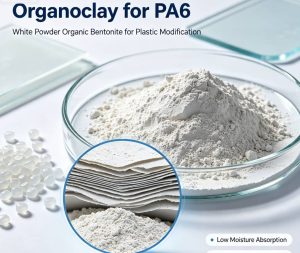
Frequently Asked Questions About Organoclay for PA6
1. What type of organoclay is suitable for PA6?
Quality organoclay for PA6 or nylon 6 organoclay is built on finely processed organomodified montmorillonite for PA6, surface‑treated to match nylon 6’s polar structure. Its organic modifier must interact with PA6 polymer chains and stay thermally stable under PA6 melt‑processing temperatures.
Key selection criteria: modifier chemistry, thermal stability, moisture content, particle size, basal spacing and dispersion capability. Valid performance of this additive needs verification via TGA, XRD, TEM, rheology and mechanical tests for target PA6 organoclay nanocomposite.
Raw material grades optimized for coatings, greases and adhesives cannot be directly applied as organoclay for PA6. Target PA6 compounding trials are mandatory prior to commercial recommendation.
2. What is the recommended organoclay dosage for nylon 6?
No universal organoclay dosage for nylon 6 fits every PA6 organoclay nanocomposite. Initial screening: 2‑5 wt% for neat PA6; 1‑3 wt% for organoclay for glass fiber reinforced PA6.
Optimal loading depends on clay grade, PA6 viscosity, screw setup, shear conditions and desired balance of stiffness, impact, flow and dimensional stability. Over‑dosage raises melt viscosity, triggers agglomeration and lowers elongation or impact performance.
Dosage figures originating from liquid‑formula applications are not valid for nylon 6 melt compounding without dedicated PA6 testing.
3. Does PA6 organoclay require a polar activator?
For melt compounding, how to disperse organoclay in PA6 relies on polymer‑clay interactions plus controlled mechanical shear. Polar activators such as ethanol or methanol are not required for PA6 extrusion.
Activator guidance designed for liquid systems cannot be migrated to PA6 melt processing. Volatile solvents will cause feeding faults, bubbles, pressure fluctuation and safety risks under high processing heat.
Standard statement for product pages: No polar activator is required for standard PA6 melt compounding. This claim shall only be published after real‑grade performance validation.
4. How should PA6 and organoclay be dried?
PA6 absorbs moisture and requires full drying before compounding. Follow resin supplier datasheet specifications. General reference: desiccant dryer at ~80 °C for 4‑8 hours, moisture adjusted to match your injection‑molding or extrusion grade.
Dry the organoclay separately according to its modifier chemistry and thermal resistance. Excess heat or long heating cycles degrade organic surface modification. Store dried materials in sealed containers or closed dry‑air feeding lines to stop re‑absorption of moisture.
Measure and control clay moisture before PA6 compounding trials. Finished PA6 organoclay nanocomposite shall be assessed under both as‑molded dry state and moisture‑conditioned state.
5. How do XRD and TEM confirm exfoliation?
Combine XRD and TEM to assess dispersion status within PA6 organoclay nanocomposite.
In XRD, a lower‑angle shift of the d001 peak signals enlarged interlayer spacing and polymer intercalation. Weak or vanished basal reflection hints extensive exfoliation, yet peak disappearance alone cannot prove full exfoliation (low clay loading or structural disorder yield similar signals).
TEM delivers direct visual proof: isolated clay platelets, intercalated stacks and large agglomerates inside PA6 matrix. Good dispersion features thinly spread platelets with minimal large tactoids.
Support XRD‑TEM findings with rheological tests. Increased low‑frequency storage modulus or yield‑like behaviour indicates well‑distributed clay platelet networks.
6. Can organoclay be used in glass‑fiber‑reinforced PA6?
Yes. Organoclay for glass fiber reinforced PA6 builds multi‑scale composites combining nano‑clay platelets and micro‑glass fibers. Proper dispersion brings improvements on stiffness, dimensional stability, creep resistance and barrier properties.
Use lower clay loading compared to neat‑PA6 formulations. Best compounding practice: disperse organoclay for PA6 inside PA6 matrix first, then feed glass fibers downstream. This preserves clay dispersion and limits excessive glass‑fiber breakage.
Characterize final compound for melt viscosity, residual fiber length, tensile‑flexural properties, impact strength, shrinkage, warpage and moisture‑aged performance. Position nylon 6 organoclay as supplementary nano‑reinforcement instead of a glass‑fiber replacement.